Posted on
The just-released 500 Years of the Crowns series is a celebration of the Crown: an enduring part of British coinage since Tudor times.
The coins in this premium collectors range from The Royal Mint feature a new Tudor rose design by Timothy Noad and are remarkable for being issued by the same Mint that struck the first Crowns in 1526.
Collectors have also noted the inclusion of two crowned royal cyphers on the reverse, that of His Majesty King Charles III, paired with the CR cypher of Her Majesty Queen Camilla. It has been centuries since a Queen Consort's initials appeared on official British coinage, making these coins a remarkable piece for coin collectors and royal enthusiasts alike.
History Of The British Crown Coin
The first Crowns - known as the Crown of the Rose - were issued during the reign of King Henry VIII as part of a sweeping reform of English coinage, overseen by Cardinal Wolsey. These rare 23-carat gold coins, inspired by the French écu au soleil, were swiftly succeeded by a 22-carat successor: the Crown of the Double Rose, named for the distinctive crowned double Tudor rose on its reverse.
The first silver Crowns were issued in 1551 during the short reign of King Edward VI, modelled after similar silver coins then circulating in continental Europe. While gold Crowns were last issued in the 17th century, the silver Crown endured as the largest and heaviest British coin in general circulation, surviving the shift to machine production and the Great Recoinage of 1816. Through the 19th century, the Crown earned a reputation as a canvas for some of the finest numismatic artistry Britain ever produced. William Wyon's renowned 1847 Gothic Crown stands as the denomination's artistic high-water mark.
By the 20th century, the Crown had quietly shifted from everyday currency to something closer to a keepsake. King George V issues, including Wreath Crowns and the celebrated 'Rocking Horse' Crown, were designed to be collected rather than spent. The denomination would later be used to mark coronations, jubilees, and moments of national significance, including the 1965 Churchill Crown, issued to mark the passing of Sir Winston Churchill. After decimalisation in 1971, the Crown continued to be issued with a nominal face value of 25p, before being re-tariffed to Five Pounds in 1990.
Today, the £5 Crown is struck purely as a collectors' piece, maintaining the denomination's long tradition of marking royal milestones, among them Elizabeth II's Platinum Jubilee and Charles III's Coronation. At the same time, the Crown has been used to celebrate broader cultural and historical themes, typified by The Royal Mint's Music Legends, Queen's Beasts and Lunar collections.
The 500 Years Of The Crown Range
The 500 Years of the Crown collection takes the Crown back to its royal roots.
The pieces in this collection share a one-off reverse, designed by renowned heraldic artist and coin designer Timothy Noad and featuring a crowned Tudor rose design, inspired by early Tudor gold Crowns with 'ANNIVERSARY OF THE GOLD CROWN' above and the dates' 1526-2026’ below. The central motif is flanked by the crowned royal cyphers of King Charles III (left) and Queen Camilla (right).
This is paired with a unique obverse, centred on Martin Jennings' definitive coinage portrait of King Charles III but encircled with a decorative border of elongated beading, characteristic of hammered and early milled coins. This is interspersed with five roses, representing the five centuries since the Crown was introduced. The obverse inscription reads 'CHARLES III · D · G · REX · F · D · 5 POUNDS · 2026 ·'.
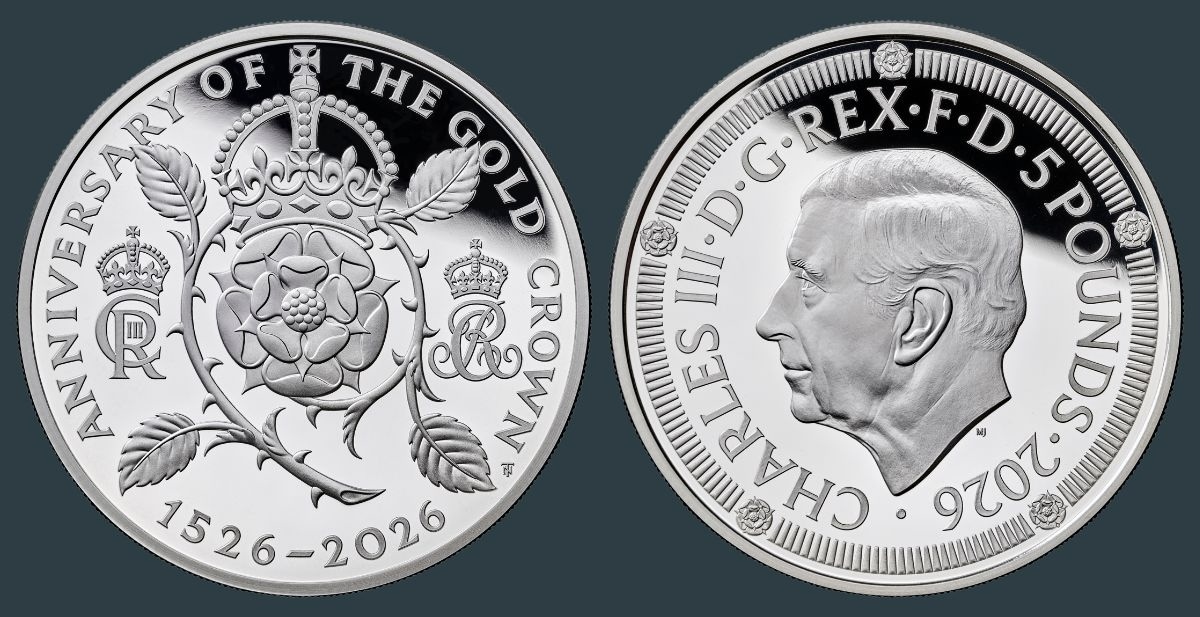
Both side of the 500 Years Of The Crown 2026 coins are unique, inspired by historic Tudor coins.
The range is primarily made up of Five Pound coins with additional sizes available in 9999 gold proof.
As a self-contained collection with a historically-inspired design and moderate mintage figures across the board, we expect pieces from the 500 Years of the Crown collection to be a popular release, especially with collectors of Crown-sized coins.
Coins With The Queen's Initials
The most notable feature of the 500 Years of the Crown collection is the inclusion of Queen Camilla's cypher alongside that of King Charles, echoing a practice dating back to the earliest Crown pieces.
After 1526, some coins issued under King Henry VIII - including the Crown of the Double Rose, the gold Halfcrown, and the Irish Harp Groat and Halfgroat - bore not only the King's initial, but also that of his current Queen Consort, placed alongside the royal 'H' on the reverse of the coin.
The earliest of these coins carried the letters H and K, for Henry and Katherine of Aragon. After Henry's divorce from Katherine in 1533 and his marriage to Anne Boleyn, new coins were issued bearing the letters H and A. Three years later, following Anne's execution in May 1536 and Henry's swift marriage to Jane Seymour, Crowns appeared with H and I lettering - I being the Latin form of Jane's initial. Although Henry went on to marry three further times, the initials of his later consorts - Anne of Cleves, Katherine Howard, and Katherine Parr - do not appear on his coinage.
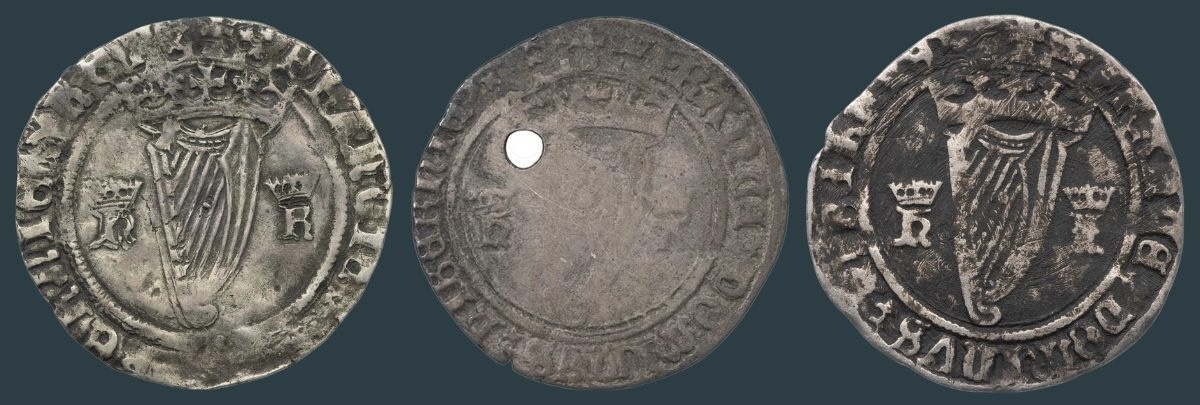
Three Irish Groats carrying (left to right) the initials of Henry VIII and Katherine of Aragon, Anne Boleyn and Jane Seymour on either side of the crowned harp.
The reasons for this custom are not entirely clear; one suggestion is that the Queen Consort may have held a seignorage right over these particular denominations. Whatever the explanation, the practice ceased long before the modern era, making the appearance of Queen Camilla's cypher on the new range a genuinely rare moment in the history of British coinage.